

If you’ve been thinking about a move in later life but find yourself putting it off or ‘feeling stuck’ you are far from alone. Indeed a Government Report suggested that 4 million older homeowners are thinking about a move, but very few actually make one. And whilst there are many practical and logical reasons for this, there’s also potentially something much more human going on: emotions.
Your home isn’t just a property
Your home is not just bricks and mortar. It’s the kitchen where you fed a family; the garden you’ve lovingly tended; the room where you’ve nursed a loved one, raised a child, grieved a parent; the street where everyone knows you. Your home is deeply entwined with your identity and the longest chapter of your life.
So when someone suggests you move – even gently, even when it’s clearly the ‘logical thing to do’ – it can feel enormous, overwhelming, and even frightening.
Moving home comes with loss
Considering leaving a home you’ve lived in for years can come with a sense of loss. Loss of that previous version of yourself; or perhaps a sense of loss of independence, status, or control. And this got me thinking, where there is loss there is grief. Grief doesn’t only come with death; it also comes at times of loss and change.
The grief cycle suggests there are five emotions commonly moved through when facing significant loss – denial, anger, bargaining, depression and acceptance. It must be said that these aren’t linear and you can fluctuate between them. However, seeing your own feelings reflected in the grief cycle can be a relief as it can give validity to your feelings and reactions which can be seen by others (and maybe even yourself) as stubbornness, procrastination, or ‘being difficult’; and it also shows that you can move through it.
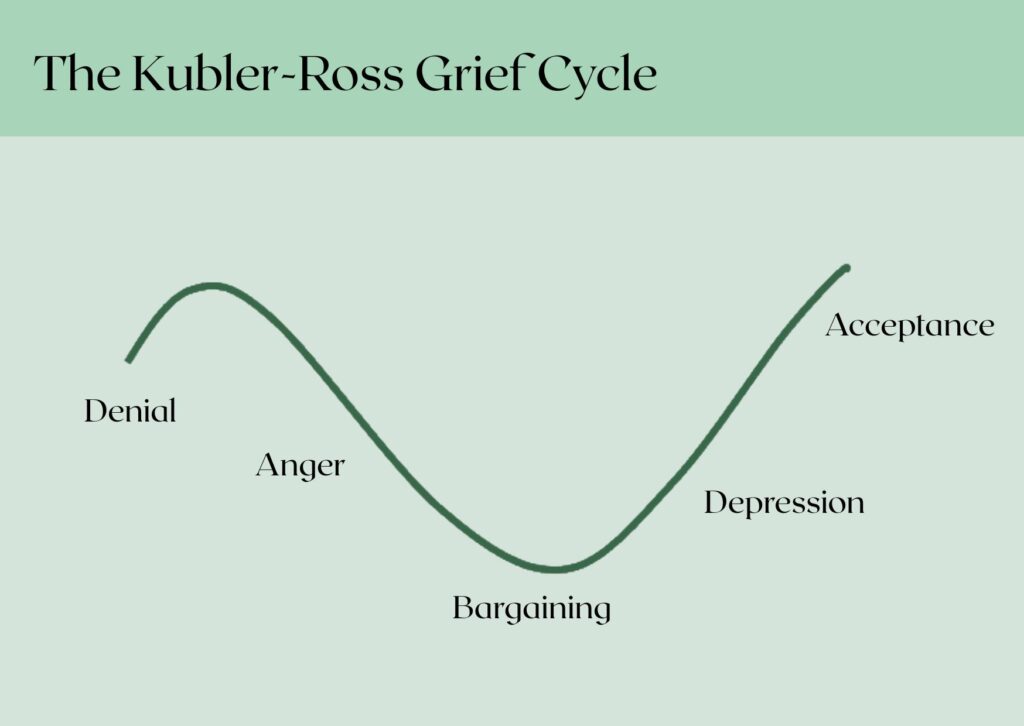
Denial might sound like: I don’t need to think about this yet. The house is fine. I’m fine. Often everything is OK, until it isn’t. Denial is a natural cushion against facing change.
Anger might sound like: Why is everyone going on about me moving? I’ve been perfectly fine here for years. Anger shows that you are, understandably, wanting to hold on to the life you had and not have it taken away from you.
Bargaining might sound like: I’ll consider it as long as I keep a garden. Or I’ll do it if it doesn’t financially penalise me. It’s an attempt to regain control.
Depression might sound like: I just can’t. Why do I need to? It comes with a heaviness, a withdrawal, a sense that none of it is worth the effort and the future feels flat. If you’re here, it’s useless for someone to list the practical benefits of moving, however true they may be. More than anything, you need to feel understood first.
Acceptance comes when you are looking forward more than backward. When you have come to terms with the fact that the current home no longer serves you, and you are starting to imagine a new chapter – perhaps even a good chapter – somewhere else.
What might actually help
The way through grief isn’t to ignore your feelings. It’s actually the opposite.
Acknowledging your feelings, even just to yourself, takes some of their paralysing power away. Sometimes writing down what you’re feeling or drawing a picture, can help when talking feels too hard. You don’t need to be a writer or an artist. The point isn’t the result, it’s giving your thoughts and feelings somewhere to go rather than going round and round in your head.
Talking to someone outside the family, who isn’t emotionally invested in the outcome and isn’t going to tell you what you should do, can help. Hearing yourself voice some of your emotions and concerns can really help with processing them.
If you can, then finding ways to share your thoughts and feelings with loved ones can be helpful. Often they are wanting to help but don’t know how and are worried about saying the wrong thing or overstepping the mark. If you can instigate the conversations it will be a huge relief for them, and it keeps you as the one in control.
When it comes to bargaining, you can start to make lists about the pros and cons of your current home: what you love, what’s starting to niggle, what’s actually something you don’t want anymore? Do you know what your priorities are for the future? Look at the various options for a new chapter with curiosity: what would it be like if… ; I’m concerned about… ; who might be able to help with… ?
Going at your own pace matters more than going at anyone else’s. Acceptance can’t be rushed by other people’s timelines. Time is, however, a gift, and there is a likelihood that at some point action will be needed, so the earlier you start this process the more likely it will be that you are the one taking that action, on your own terms, and with the right support around you.
Moving in later life is rarely just a move. It’s an emotional transition that involves ending the largest chapter of your life before a new chapter – and a new identity – are fully formed. Understanding that isn’t a luxury – it’s the first real step towards finding your way through it, in your own time, on your own terms.
Susan Gregory is the founder of Turners Oak, a specialist advisory and estate agency service that specifically works with older homeowners and their families. They understand that moves in later life are unique and complex, and work with clients at every stage – from the first thoughts about a potential move through to moving day itself.
Susan Gregory www.turnersoak.co.uk Advice Line: 020 3916 6045