
This month’s guest blog is written by Charlotte Skinner, Brand Ambassador for Lumiio.
Over the course of living with dementia, 70% of individuals will go wandering and missing at least once. This is a scary statistic when you consider the higher risks associated with going missing with dementia, as it creates a greater likelihood of serious injury caused by dehydration, missed medication, being involved in a traffic accident, falls, and hypothermia or hyperthermia.
For those living with dementia, ‘wandering’ is a behaviour associated with repeated walking. The issue arises when individuals with dementia start wandering outside of the home and become disorientated, confused, or unable to find their way back.
Wandering is a hotly debated term as many feel it implies a lack of purpose, whilst dementia wandering is instead associated with an individual searching for a need to be fulfilled. Due to this, many will describe it as ‘dementia walking’, ‘walking about’, or ‘walking with purpose’. Police and councils do however mostly refer to the behaviour as wandering.
As aforementioned, often when an individual with dementia begins to wander, it signifies that they have a need that is not being met. The needs could be discomfort, boredom, distress, hunger or thirst. Due to communication issues that can develop with dementia, many individuals are unable to make these needs known and ‘walk about’ in search for them to be met. Equally, the individual may simply be following a routine that they used to or currently have, or a desire to go outside and visit a place, where they then become confused or disorientated.
Wandering not only causes individuals with dementia to go missing, which in turn puts them at greater risk of harm, it also causes emotional and mental upset for the individual, their loved ones, and carers. If your loved one with dementia goes wandering and you are unable to find them, immediately begin searching within a radius of 1.5 miles from their last known location. Do not hesitate to call the police to report them missing, as you do not have to wait 24 hours if you believe a vulnerable individual may be lost.
To safeguard the risks of wandering whilst ensuring those with dementia retain their independence, it is crucial to utilise measures that both prevent it and support identification in the event of wandering. It is critical to ensure that those living with dementia feel comfortable with their independence for as long as possible, as having more control and a sense of accomplishment provides immeasurable quality of life.
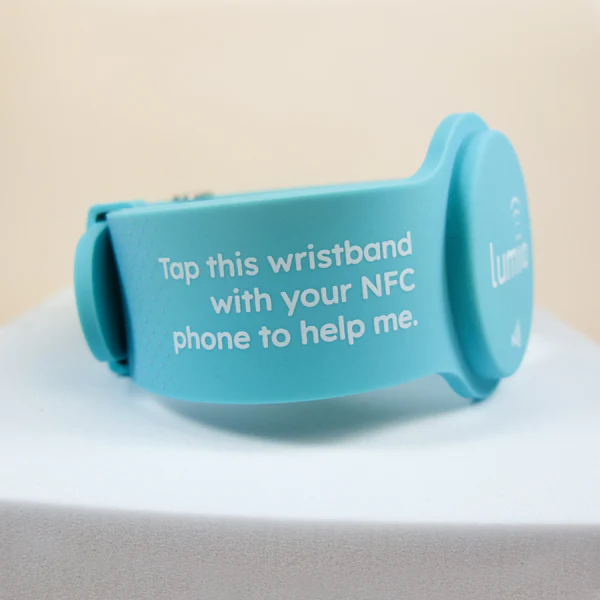
Measures to prevent wandering include home alarms and GPS trackers; however, many individuals dislike being tracked or live alone. To safeguard risk in the event of wandering, it is important for individuals with dementia to carry identification; this is why safeguarding technology developer Lumiio created our wearable, NFC-enabled IDs. NFC stands for Near Field Communication. It’s the technology that allows information to be shared with a simple tap. Most people already use NFC every day when they:
- Tap a bank card to pay
- Use Apple Pay or Google Pay
- Tap an Oyster card on the Tube
Our products work in exactly the same way. When someone taps the product with a smartphone, important information can instantly appear on their screen.
Lumiio products make a vulnerable individual’s essential personal information instantly and securely accessible with a simple tap and hold of any modern smartphone, with no app necessary. This essential information includes their name, two emergency contacts, and key details including diagnosis or communication preferences, which in turn allows the responder to act accordingly, quickly and appropriately.
We designed our Dementia Collection with comfort in mind, and it includes our Soft-Touch Wristbands, in both bright yellow and pink, but also our more discreet products such as Hangtags, Key Fobs, and Connect Cards. To learn more about Lumiio or view our product collections visit https://lumiio.io/, or reach out to the team via the email hello@lumiio.io or call 020 4551 1450.